

The government’s affordable housing initiative, Apni Chhat Apna Ghar Scheme, was introduced with the goal of providing low-cost housing to underserved communities. It aimed to reduce the housing shortage and improve living standards for low-income families across the province. However, recent developments show that the project is facing serious financial and administrative challenges.
One of the major concerns is the delay in securing funding, which has slowed down progress significantly. The inability to meet key performance targets has not only affected financial inflows but also raised questions about the overall implementation strategy of the program.
Overview of Funding Challenges
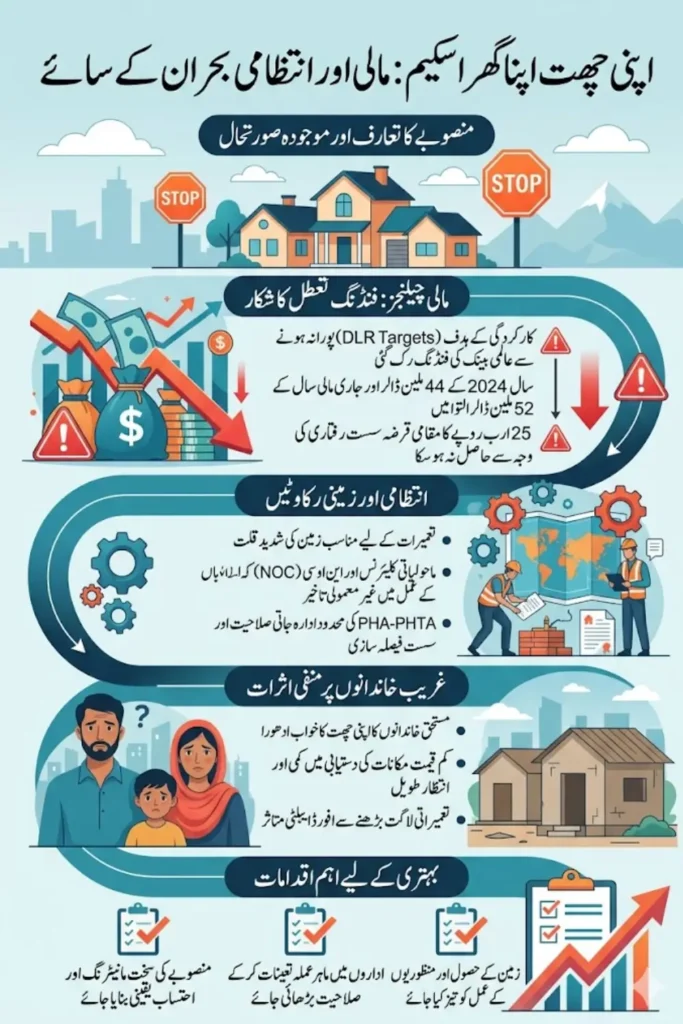
The housing scheme has encountered difficulties in obtaining a Rs25 billion loan that was crucial for its execution. This loan was directly linked to the progress of the project, meaning that failure to achieve milestones has resulted in delayed financial support.
Additionally, international funding expected from the World Bank has also been stalled. The release of funds under the Disbursement Linked Results (DLR) system depends on achieving specific targets, which have not been met so far.
- Rs25 billion loan could not be secured due to slow progress
- $90 million World Bank funding delayed
- Performance-based funding model affecting cash flow
- Project timeline extended due to financial uncertainty
These funding issues have created a chain reaction, impacting construction timelines and overall project delivery.
You can also read: Jaecoo J7 2026 Price in Pakistan
Delays in World Bank Funding and DLR Targets
The Disbursement Linked Results (DLR) system requires governments to meet predefined goals before funds are released. In this case, the scheme has failed to achieve those benchmarks, resulting in significant delays in financial disbursement.
In 2024, around $44 million was expected but has not yet been released. Similarly, an additional $52 million for the current fiscal year remains pending. This has created a funding gap that is slowing down the entire project.
| Funding Component | Expected Amount | Status | Impact on Project |
|---|---|---|---|
| World Bank Funding (2024) | $44 million | Not Released | Delayed construction |
| Current Fiscal Year Funding | $52 million | Pending | Slowed project expansion |
| Local Loan | Rs25 billion | Not Secured | Major financial setback |
The delay in these funds highlights the importance of meeting performance targets in international funding agreements.
Land Shortage and Environmental Approval Issues
Another major hurdle in the implementation of the housing scheme is the lack of available land. Identifying suitable land for construction has proven to be a slow and complex process, delaying project initiation in several areas.
Environmental approvals have also contributed to the slowdown. These approvals are necessary to ensure sustainable development, but delays in the approval process have further pushed back construction timelines.
- Limited availability of suitable land
- Delays in land acquisition processes
- Slow environmental clearance procedures
- Increased project costs due to delays
These challenges show that planning and coordination need improvement to avoid future setbacks.
Institutional Capacity and Administrative Limitations
The role of the housing authority is critical in executing such large-scale projects. However, limited institutional capacity has been identified as a major obstacle. The Khyber Pakhtunkhwa Housing Authority (PHA-PHTA) has struggled with administrative efficiency and timely decision-making.
A lack of skilled personnel and streamlined processes has slowed down approvals and implementation. This has directly impacted the ability to meet funding conditions and project deadlines.
- Weak administrative systems
- Delays in decision-making processes
- Limited technical expertise
- Poor coordination between departments
Improving institutional strength is essential for ensuring the success of such initiatives.
Impact on Low-Income Families
The delays in the housing scheme are not just administrative issues—they directly affect the people it was designed to help. Low-income families who were expecting affordable housing solutions are now facing uncertainty.
The slowdown in development means fewer housing units are being completed, leaving many families without access to safe and affordable homes.
- Reduced availability of affordable housing
- Increased waiting time for beneficiaries
- Continued housing insecurity
- Rising construction costs affecting affordability
This situation highlights the importance of timely project execution in social welfare programs.
You can also read: BISP 8171 ATM Withdrawal Guide
Key Areas for Improvement
To overcome these challenges, several steps need to be taken to improve the efficiency and effectiveness of the housing scheme.
- Strengthen institutional capacity with skilled staff
- Improve coordination between departments
- Speed up land acquisition and approval processes
- Ensure timely monitoring of project milestones
- Align targets with realistic timelines
Addressing these areas can help restore progress and rebuild confidence in the project.
Conclusion
The Apni Chhat Apna Ghar Scheme remains a vital initiative for addressing housing shortages, but its success depends on overcoming current challenges. Financial delays, administrative inefficiencies, and planning gaps have slowed progress, but they also provide an opportunity to improve systems and processes.
With better management, timely approvals, and stronger institutional support, the scheme can still achieve its goals. Ensuring accountability and meeting funding conditions will be key to unlocking financial resources and delivering affordable housing to those who need it most.